Layout Pattern
Matrix
Show four parts that together make a whole, or the four cases of two choices, as a 2 x 2 matrix. Write four short list entries, in the order top left, top right, bottom left, bottom right; another count is drawn as a grid of cards.
How to Use It
Show four parts that together make a whole, or the four cases of two choices, as a 2 x 2 matrix. Write four short list entries, in the order top left, top right, bottom left, bottom right; another count is drawn as a grid of cards.
Preview + source
Explore this layout
Divide one whole into four parts, one short entry per quadrant.
All people, quotations and business figures in these examples are illustrative.
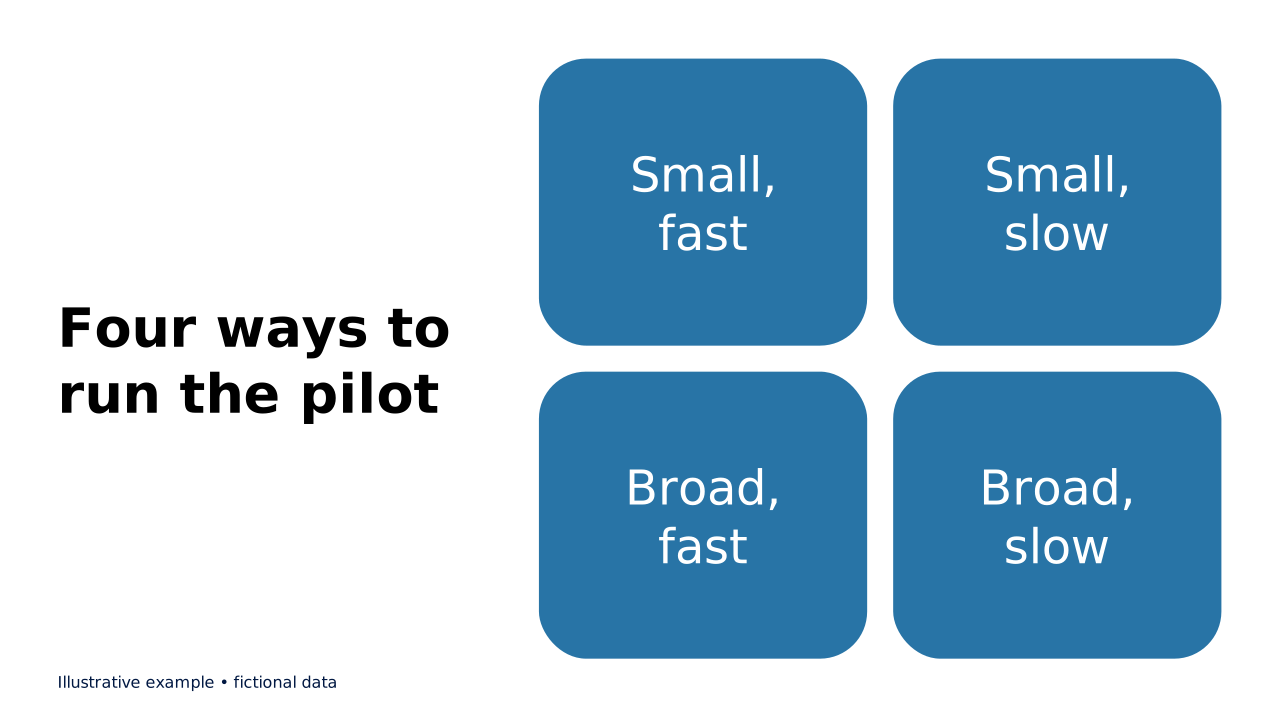
This prepared preview and the OPF describe the same example. Region outlines show measured allocation; toggling them does not change the slide.
Inspect compact default-catalog references. Your host must register the matching catalog; source identifies it without fetching over the network. Copy always includes complete embedded records.
{5 keys
"design": {2 keys
"footer": {1 key
"left": {1 key
"slides": [1 item
{3 keys
"blocks": [1 item
{2 keys
"items": [4 items
"catalogs": {1 key
"default": {1 key
Regions, in reading order
This layout is one list of 2 regions, declared once. The list runs as a row; a split nests a list that runs the other way. Each size is a share of its parent’s width (row) or height (column).
Schematic of the list: each box is drawn in proportion to its size; an auto entry gets a fixed band. Dashed boxes are heading regions.
Row, side by side, left to right. No anchor is written on the layout: body regions start at the top unless they set their own.
- 1title40%
size 2: 40% of the width
Heading region: holds the slide’s title, with its tag and subtitle. It takes a size and no content rules.
- 2quadrants60%
size 3: 60% of the width
- Accepts
- list
- Role
- primary
- Flow
- none, up to 1 block
- Anchor
- top (default)
Layout structure and reference fields
How automatic composition differs
Try dynamic composition
Explore how a text slide reflows as you change its content and shape. These examples use OPF’s shared composition rules; the copied document includes your choices.
All sample text fits within its content boxes.
View the complete OPF example
{
  "$schema": "https://openpresentation.org/schema/opf/v1",
  "name": "Dynamic composition example",
  "design": {
    "dimensions": {
      "widthInches": 13.333333333333334,
      "heightInches": 7.5
    }
  },
  "slides": [
    {
      "title": "Let the content find its space",
      "composition": {
        "mode": "auto"
      },
      "blocks": [
        {
          "text": "Start with the decision. State what the audience should understand or do."
        },
        {
          "text": "Show the evidence. Give each supporting idea enough space to be read."
        },
        {
          "text": "Make the next step clear. Keep the action specific and easy to remember."
        }
      ]
    }
  ]
}
Composition rules and examples as JSON · Pagination rules and example JSON
Related Layouts
Similar OPF layout slugs with matching content types, spatial patterns, or presentation use cases.
Groups Of Items
Chevrons
Show 1 to 8 stages that follow one another, each leading into the next. Write one short list entry per stage, in order; a word or two reads best inside a chevron.
/layouts/chevrons
Groups Of Items
Cycle
Show 2 to 8 steps that repeat, where the last leads back to the first (a review loop, a product lifecycle, a feedback cycle). Write one short list entry per step, in order; the first is drawn at the top and the rest clockwise, with an arrow from each to the next.
/layouts/cycle
Groups Of Items
FAQ
Answer the questions an audience is likely to ask. Pair each question with a direct answer and group related questions together.
/layouts/faq
Groups Of Items
Flow
Show 1 to 8 steps that follow one another, each a box with an arrow to the next. Write one short list entry per step, in order.
/layouts/flow
Groups Of Items
Pyramid
Show a hierarchy of 1 to 8 levels, from the narrow top (the peak, the few, the goal) to the broad base (the foundation, the many). Write one short list entry per level, the top level first.
/layouts/pyramid
Groups Of Items
Vertical flow
Show 1 to 8 steps that follow one another from top to bottom, each a box with an arrow to the next, beside the title. Write one short list entry per step, in order.
/layouts/vertical-flow