Layout Pattern
Text
Explain one idea in continuous prose. Use paragraphs or flowing blocks for detail that needs to be read in sequence.
How to Use It
Explain one idea in continuous prose. Use paragraphs or flowing blocks for detail that needs to be read in sequence.
Preview + source
Explore this layout
Explain one connected argument with a clear heading and short supporting copy.
All people, quotations and business figures in these examples are illustrative.
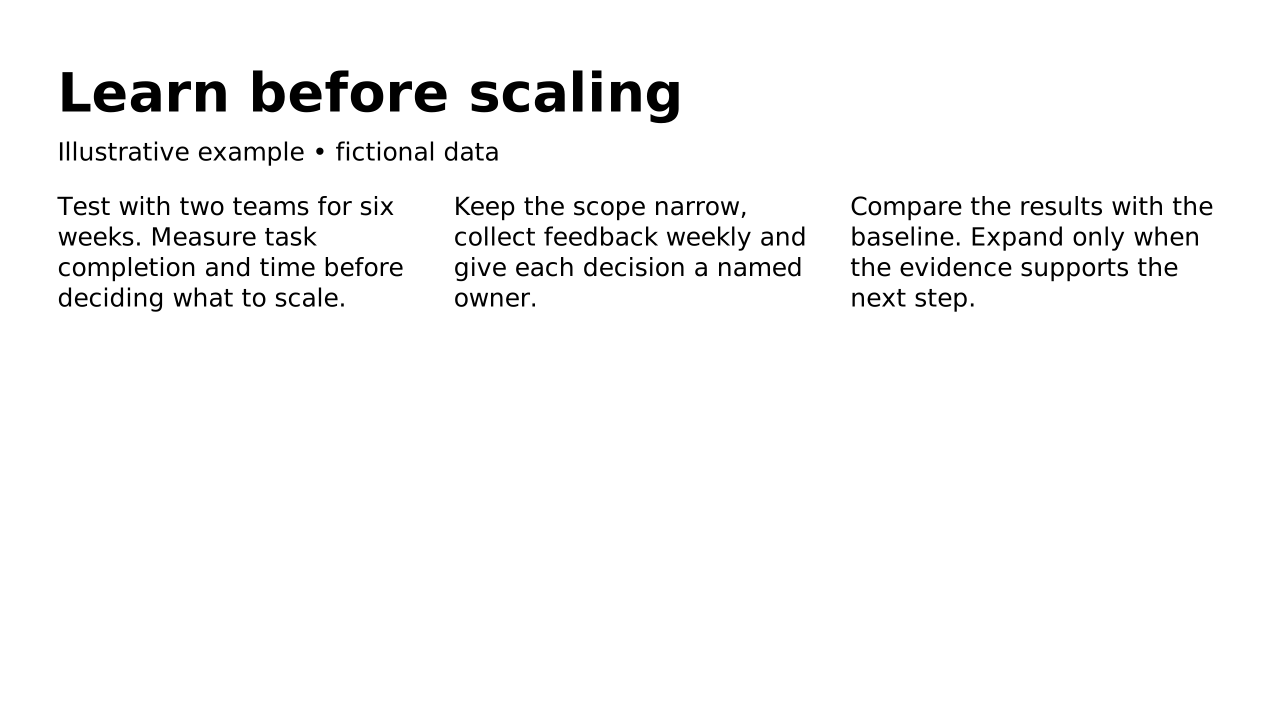
This prepared preview and the OPF describe the same example. Region outlines show measured allocation; toggling them does not change the slide.
Inspect compact default-catalog references. Your host must register the matching catalog; source identifies it without fetching over the network. Copy always includes complete embedded records.
{5 keys
"design": {2 keys
"footer": {1 key
"left": {1 key
"slides": [1 item
{3 keys
"blocks": [3 items
{2 keys
{2 keys
{2 keys
"catalogs": {1 key
"default": {1 key
Regions, in reading order
This layout is one list of 2 regions, declared once. The list runs as a column; a split nests a list that runs the other way. Each size is a share of its parent’s width (row) or height (column).
Schematic of the list: each box is drawn in proportion to its size; an auto entry gets a fixed band. Dashed boxes are heading regions.
Column, stacked, top to bottom. No anchor is written on the layout: body regions start at the top unless they set their own.
- 1titleauto
auto, the height the content needs
Heading region: holds the slide’s title, with its tag and subtitle. It takes a size and no content rules.
- 2body100%
size 1: 100% of what the auto entries leave
- Accepts
- textlistquotecodegroup
- Role
- primary
- Flow
- auto, up to 6 blocks
- Anchor
- top (default)
Layout structure and reference fields
How automatic composition differs
Try dynamic composition
Explore how a text slide reflows as you change its content and shape. These examples use OPF’s shared composition rules; the copied document includes your choices.
All sample text fits within its content boxes.
View the complete OPF example
{
  "$schema": "https://openpresentation.org/schema/opf/v1",
  "name": "Dynamic composition example",
  "design": {
    "dimensions": {
      "widthInches": 13.333333333333334,
      "heightInches": 7.5
    }
  },
  "slides": [
    {
      "title": "Let the content find its space",
      "composition": {
        "mode": "auto"
      },
      "blocks": [
        {
          "text": "Start with the decision. State what the audience should understand or do."
        },
        {
          "text": "Show the evidence. Give each supporting idea enough space to be read."
        },
        {
          "text": "Make the next step clear. Keep the action specific and easy to remember."
        }
      ]
    }
  ]
}
Composition rules and examples as JSON · Pagination rules and example JSON
Related Layouts
Similar OPF layout slugs with matching content types, spatial patterns, or presentation use cases.
Text
Three columns
Place three independent bodies of content beside each other. Keep equivalent comparisons parallel and use fewer columns when content needs more width. Pictures remain visible in full unless an explicit fit overrides the layout default.
/layouts/three-column
Text
Two columns
Place two bodies of content beside each other. Use it for paired explanations or an argument with supporting evidence. Pictures remain visible in full unless an explicit fit overrides the layout default.
/layouts/two-column
Text
List
Present several related points in a clear sequence. Use bullets for independent points or numbered items for an ordered list.
/layouts/list
Openers And Closers
Closing
End with the action the audience should take. Include contact details or a brief thank-you when useful.
/layouts/closing
Groups Of Items
Pillars
Show the main themes or principles behind an idea. Give each item a short heading and a comparable amount of detail.
/layouts/pillars
Text
Quote
Highlight a quotation and its source. Use the attribution to explain who said it and why their perspective matters.
/layouts/quote